You paste a long report into an AI tool and ask for a summary. Will it read every page, or quietly run out of room halfway through?
What a Context Window Is
A model’s context window is its working memory for one request: the most tokens it can take in and produce at once. A token is a small piece of text, about three quarters of an English word on average (see What Is a Token in AI?).
Think of it as a desk. Everything the model needs for this job (your instructions, the document, the chat so far and the space to write its answer) has to fit on the desk at the same time. Anything that doesn’t fit simply isn’t there.
How Big Are They Now?
Context sizes as listed on each model’s page on our price board, checked on 2026-11-22:
| Context window | Models | Examples |
|---|---|---|
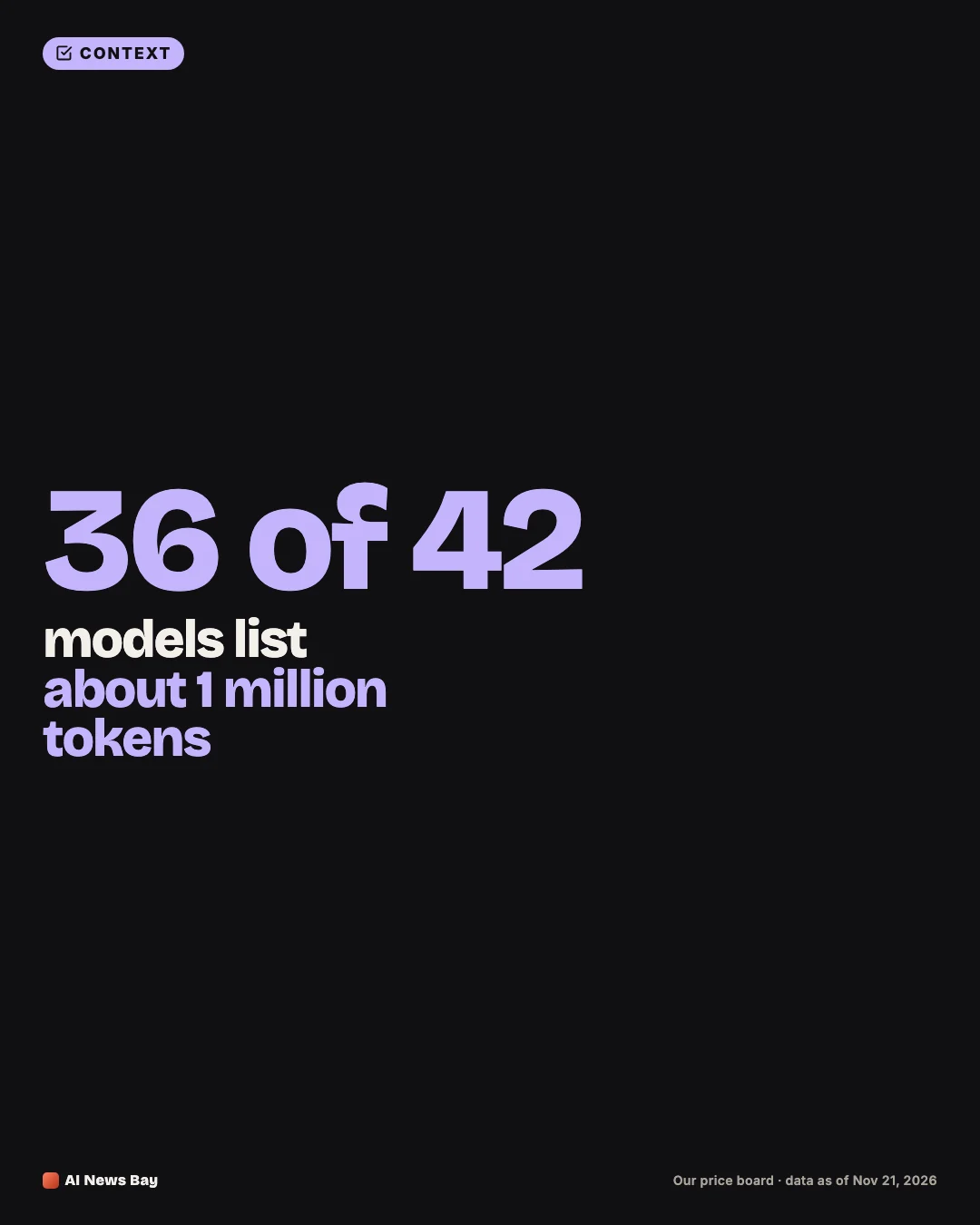
| About 1 million tokens | 36 | Most current models from OpenAI, Anthropic, Google, DeepSeek, Moonshot AI, Z.ai and MiniMax, plus Mistral Large 4 |
| 500,000 tokens | 1 | Grok 4.7 |
| 256,000–262,144 tokens | 3 | Mistral Small 4, Ministral 3 14B, Kimi K2.7 Code |
| 200,000 tokens | 1 | Claude Haiku 4.5 |
| 128,000 tokens | 1 | Codestral 25.08 |
Note, 2026-11-22: Kimi K2.7 Code is deprecated. Moonshot AI’s models page says it is closed to newly registered users and expected to retire in late December 2026.
Did you know? About 1 million tokens is roughly 750,000 English words: about ten novels of 75,000 words each, in a single request.
What Fills the Window
People often count only the document they paste. The window also has to hold:
- Your instructions (the system prompt), sent with every request
- The conversation so far, which grows with every message in a chat
- The model’s answer, which needs room too
- Hidden reasoning: OpenAI’s reasoning guide notes that reasoning tokens aren’t visible but still take up space in the context window
So a model with a 200,000-token window can’t read a 200,000-token document and also answer at length.
Bigger Isn’t Always Cheaper
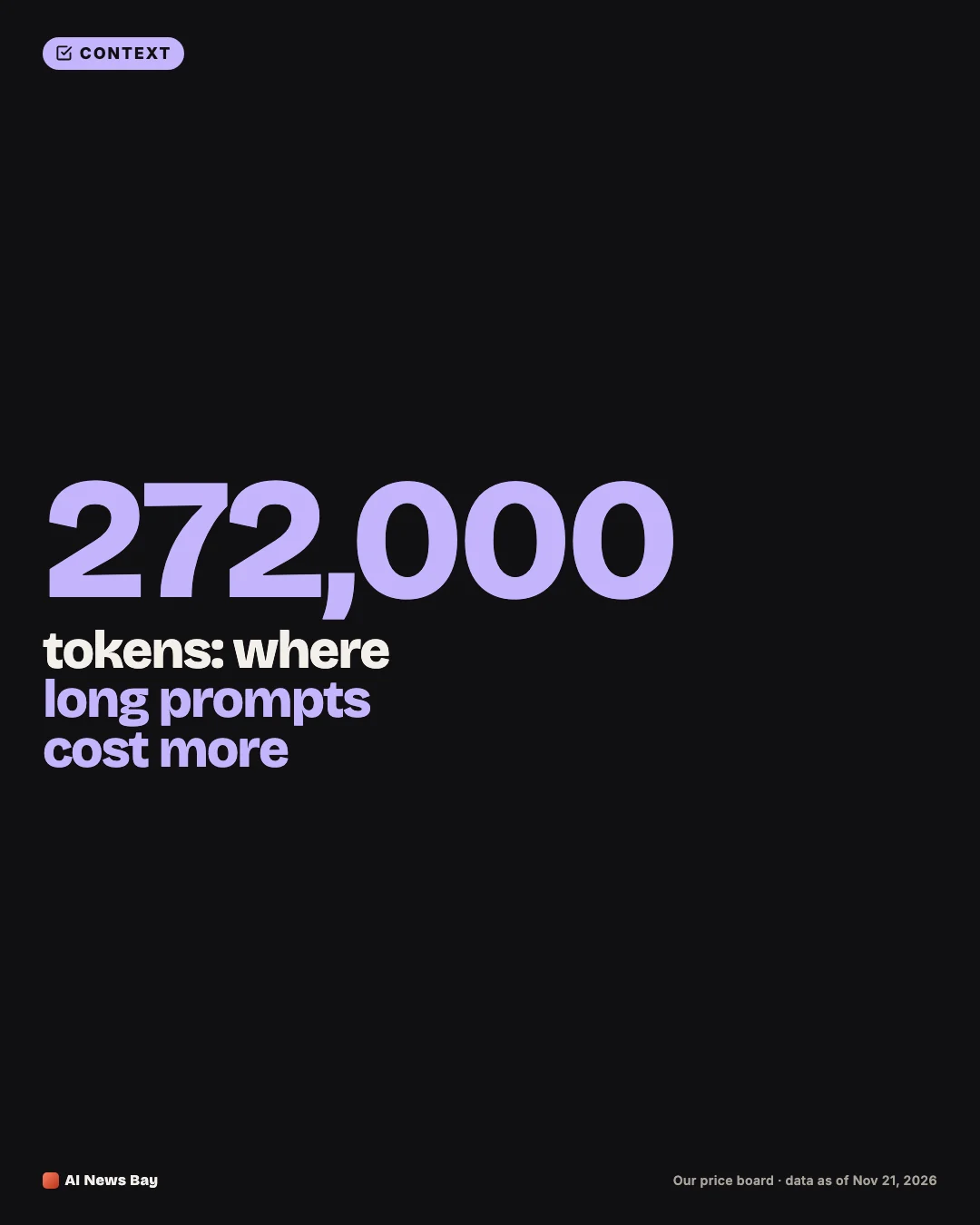
A large window is one thing; what it costs to fill is another. Several providers charge more once a prompt passes a size line, and the whole request is then billed at the higher rate:
| Model | Higher price starts above | Input price (normal → long) |
|---|---|---|
| Claude Haiku 5.5 | 100,000 tokens | $0.10 → $0.50 per 1M |
| Gemini 2.5 Pro | 200,000 tokens | $1.25 → $2.50 per 1M |
| Current OpenAI models (for example GPT-6.2 Sol) | 272,000 tokens | $2.00 → $4.00 per 1M |
Note, 2026-11-22: Gemini 2.5 Pro is deprecated and retires on 2026-12-01. Google’s deprecations page says its API requests then go to Gemini 3.8 Flash, billed at Gemini 3.8 Flash rates.
Others don’t. Anthropic’s pricing page says Claude 4.6 and later models, except Claude Haiku 5.5, include the full 1 million token window at standard pricing. On our board, the Gemini 4 models list one price at every prompt length.
A Worked Example
A support chat on GPT-6.2 Sol ($2 input, $10 output per 1M tokens on our board, with a long-prompt price above 272,000 tokens):
- System prompt: 2,000 tokens
- Twenty earlier messages: about 6,000 tokens
- A help article pasted in: 15,000 tokens
- The answer: 1,000 tokens
That’s 23,000 tokens in and 1,000 out, well inside the window, and about $0.056 per request. Now imagine the app pastes a 300,000-token code base instead. The prompt crosses the 272,000-token line, input is billed at $4 per 1M and output at $15, and one request (about 308,000 tokens in and 1,000 out) costs about $1.25, over 20 times as much. Sending only the relevant files would keep it under the line.
Do You Need a Big Window?
| Task | Typical size | A 200,000-token window is… |
|---|---|---|
| A chat reply with some history | a few thousand tokens | plenty |
| Summarizing a 30-page report | about 15,000–20,000 tokens | plenty |
| Reading a long book or a large code base | hundreds of thousands of tokens | not enough; look for about 1 million |
Sizes are rough estimates for English text. Count real tokens with your provider’s tools before you rely on them.
Practical Tips
- Send what matters, not everything. Relevant sections usually beat a whole archive.
- Summarize old chat turns instead of resending them in full.
- Leave room for the answer, especially with reasoning models.
- Watch price lines if your prompts are near 100,000, 200,000 or 272,000 tokens.
- Re-check after model changes. Window sizes and price lines can change with each new model, so confirm them before you switch.
What This Means for You
- Developers: budget the window: instructions + history + document + answer + reasoning, with a safety margin, and check the model’s price lines.
- Founders and team leads: a 1-million-token window lets you analyse very large documents in one go, but the bill grows with every token you send.
- Curious beginners: a context window is how much an AI can “keep in mind” at once; today’s big models can hold several books’ worth.
Copy-Ready Context Budget
- System prompt: ____ tokens
- Conversation history kept: ____ tokens
- Document or data sent: ____ tokens
- Room for the answer (and reasoning): ____ tokens
- Total (must be under the model’s window, with a margin): ____ tokens
- Is the total above the model’s long-prompt price line? Yes / No
What’s the longest document you’d want an AI to read in one go?
Bottom Line
A context window is the model’s working space for one request, and on our board most models now offer about 1 million tokens. Fill it wisely: everything you send counts, including the answer and hidden reasoning, and some models charge more past a size line. Compare models on our price board, use our 7-question model checklist, and see How LLM API Pricing Works. Want these updates by email? Sign up here, or follow new guides and data stories through our RSS feed.