You type a question, and a few seconds later a full, fluent answer appears. What’s actually happening on the other side of the screen?
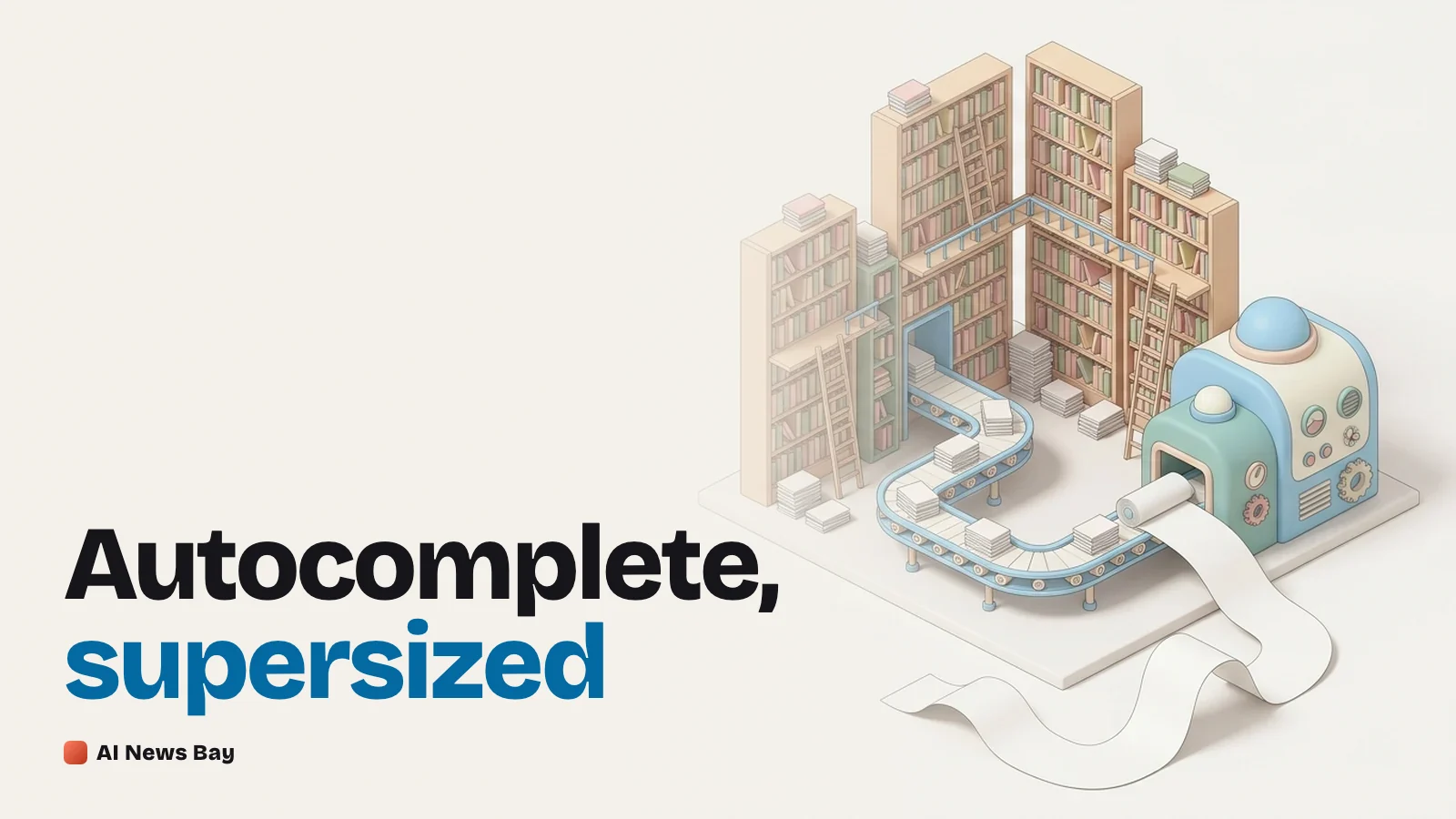
The Short Version: Autocomplete, Supersized
Your phone’s keyboard suggests the next word as you type. A large language model does something similar, at a vastly bigger scale. It reads the text so far and predicts the most likely next piece, then the next, until it has written a whole answer.
Google’s Machine Learning Crash Course describes LLMs as models that predict sequences of tokens, small units of text that can be a word, part of a word or a single character. Our explainer What Is a Token in AI? covers tokens in more detail. The course also puts it bluntly: a model trained on many maths word problems can look as if it’s reasoning when it is basically autocompleting the prompt.
What Makes It “Large”
Two things, according to Google’s course, make LLMs much better at prediction than older language models:
- Far more parameters. Parameters are the internal numbers the model adjusts during training. You can think of them as a huge number of tiny dials.
- Far more context. An LLM can take much more of the surrounding text into account when it predicts the next token.
That context can be very long today. On our price board on 2026-11-21, 36 of the 42 models we track listed a context window of about 1 million tokens, roughly 750,000 English words in one request.
How It Learns
Building an LLM happens in stages:
- Pre-training. The model reads an enormous amount of text and learns, by trial and error, to predict missing or next tokens. Google’s course notes this can take months and enormous amounts of computing power and electricity.
- Fine-tuning. The model is then trained further on narrower examples, for instance to follow instructions or to work in a specific field.
- Using it. When you send a prompt, the trained model runs its predictions. This step is called inference, and it’s what API providers charge for per token.
Did you know? Most modern LLMs are built on an architecture called the Transformer. Its key idea, self-attention, lets the model weigh how much every other token in your text should affect its reading of each token. In other words, it works out what each word means from the words around it.
What LLMs Are Good At
- Writing and rewriting text for different readers
- Summarizing long documents
- Translating between languages
- Answering questions and explaining ideas
- Writing and reviewing code
- Turning messy text into structured lists or tables
Where They Go Wrong
Google’s course lists the problems plainly:
- They hallucinate: their predictions often contain mistakes, stated with confidence. A fluent answer isn’t the same as a correct one.
- They use a lot of computing power and electricity, both to train and to run.
| Myth | Fact |
|---|---|
| An LLM looks facts up in a database | It predicts text from patterns learned in training, unless it’s connected to a search or document tool |
| A confident answer is a correct answer | LLMs can state mistakes confidently; check anything important |
| All LLMs are the same | They differ widely in size, skill, context length and price |
Many Models, Many Prices
There isn’t one LLM; there are hundreds. On 2026-11-21 our price board tracked 42 models from 9 providers. Twelve of them were open-weight, meaning anyone can download and run them. Prices ranged from $0.10 to $10 per million input tokens. Smaller models are cheaper and faster, and larger ones usually handle harder tasks.
What This Means for You
- Developers: treat the model as a powerful text predictor. Give it clear context, check its output, and connect it to tools or documents when facts matter.
- Founders and team leads: LLMs are good at drafting, summarizing and sorting text; keep a person in the loop for anything customer-facing or high-stakes.
- Curious beginners: an LLM is a very large autocomplete. It’s brilliant with language, but double-check facts, numbers and quotes it gives you.
Copy-Ready Prompt for Checking an Answer
Paste this after any answer you plan to rely on:
List every factual claim in your answer above. For each one, say how confident you are and what source I could check it against.It won’t make the model always right, but it shows you which parts to verify.
What’s one task in your week that’s mostly reading, sorting or rewriting text?
Bottom Line
A large language model predicts text one token at a time, trained on vast amounts of writing. That makes it fluent and versatile, but it can be wrong with confidence. Use it for drafting and sorting, and check what matters. Next, read What Is a Token in AI?, browse our collection How large language models work inside, or start from Start here if you’re new to AI. Want these updates by email? Sign up here, or follow new guides and data stories through our RSS feed.