Some AI models you can download and run yourself; others you can only rent through a website or an API. Which kind you choose shapes your costs, your control over data and how much work you take on.
The Two Kinds
- Open-weight models publish their weights: the trained numbers, also called parameters, that make the model work. With the weights you, or any hosting company, can run the model on your own hardware, adjust it and keep it as long as you like.
- Closed models keep their weights private. You use them only through the maker’s API, its apps or its cloud partners.
Think of a recipe. An open-weight model gives you the finished recipe card to cook at home. A closed model is a restaurant: you can order the dish, but the kitchen stays behind the door.
Open Weights Aren’t the Same as Open Source
The Open Source Initiative’s definition of open source AI asks for more than weights. It also wants:
- the code used to train and run the system
- detailed information about the training data, so a skilled person could build a substantially equivalent system
Many open-weight models publish weights under their own licence terms without all of that. So open-weight is the accurate word for most of them; check each model’s licence before you build on it.
Which Models on Our Board Are Which
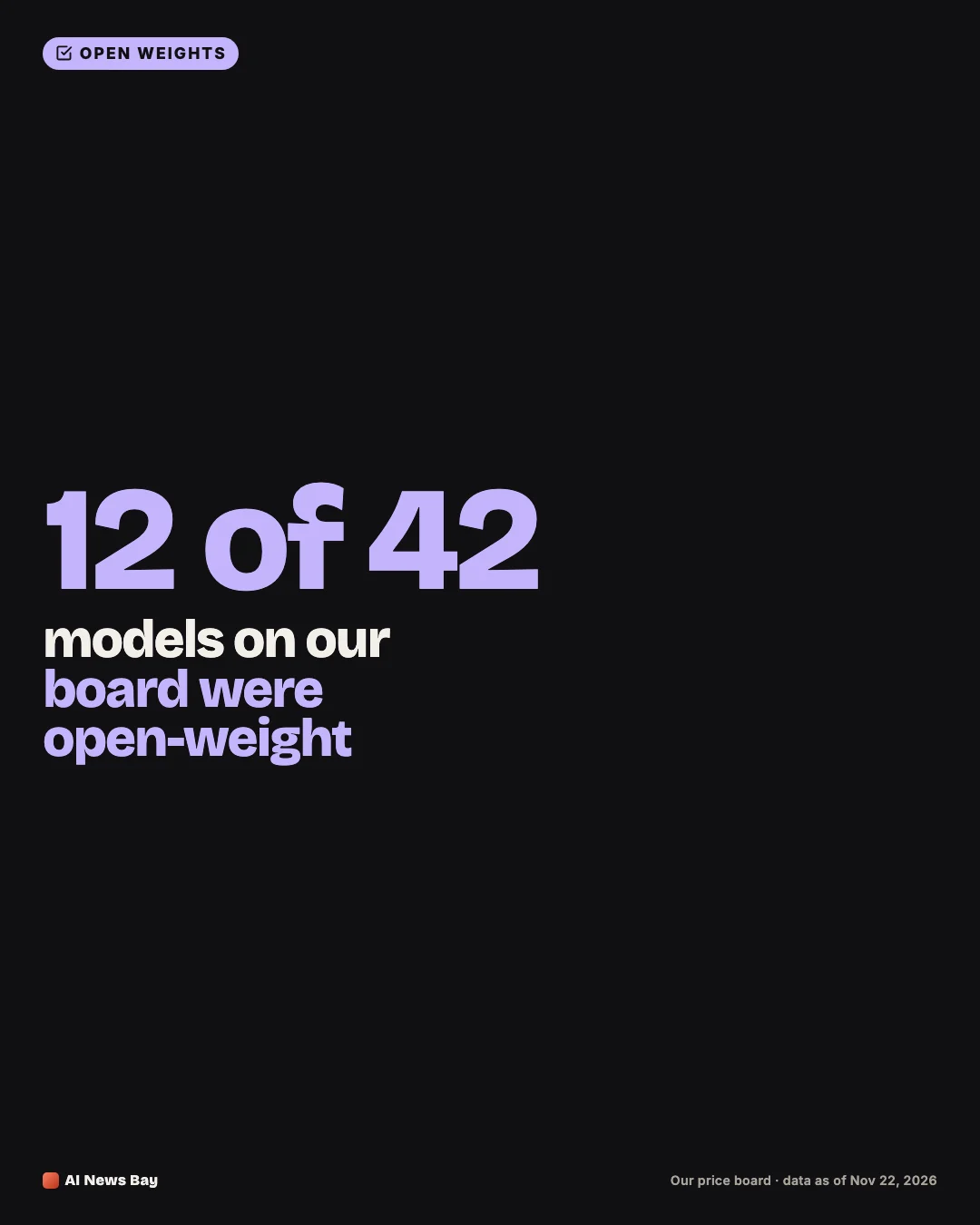
On our price board on 2026-11-22, 12 of the 42 models were marked open-weight:
| Provider | Open-weight models on our board |
|---|---|
| Mistral AI | Mistral Large 4, Mistral Small 4, Ministral 3 14B |
| DeepSeek | DeepSeek V4.1 Flash, DeepSeek V4 Pro |
| Moonshot AI | Kimi K3.1 Pro, Kimi K3, Kimi K2.7 Code |
| Z.ai (Zhipu) | GLM-5.3, GLM-5.3-Flash |
| MiniMax | MiniMax M3.1 Flash, MiniMax M3 |
Note, 2026-11-22: On Moonshot AI’s own API, Kimi K2.7 Code is deprecated. Its models page says the model is closed to newly registered users and expected to retire in late December 2026.
Every model we track from OpenAI, Anthropic, Google and xAI was closed, as were Codestral 25.08 and GLM-5.3-FlashX. Our board’s flags were corrected on 2026-11-22 against each maker’s own page: Mistral Large 4 is published as open-weight under Mistral’s own licence, while no weights are published under the GLM-5.3-FlashX name. Always check a model’s licence on its maker’s page.
Did you know? Open-weight models can also be used through their maker’s own API, at API prices. For example, DeepSeek’s pricing page lists both of its open-weight models with hosted prices. You don’t have to run them yourself to use them.
The Trade-Offs
| Open-weight | Closed | |
|---|---|---|
| Where it runs | Your hardware, a hosting company, or the maker’s API | The maker’s API, apps or cloud partners |
| Control over data | Can stay entirely inside your systems | Goes to the provider under its terms |
| Model version | You keep the exact version as long as you like | The provider can update or retire it |
| Effort | You (or a host) handle servers, scaling and updates | The provider handles it |
| Price | API prices tend to be lower on our board; self-hosting costs hardware and staff time | Per-token API prices |
| Typical top capability | Varies; check your own tests | Includes every flagship from the largest labs on our board |
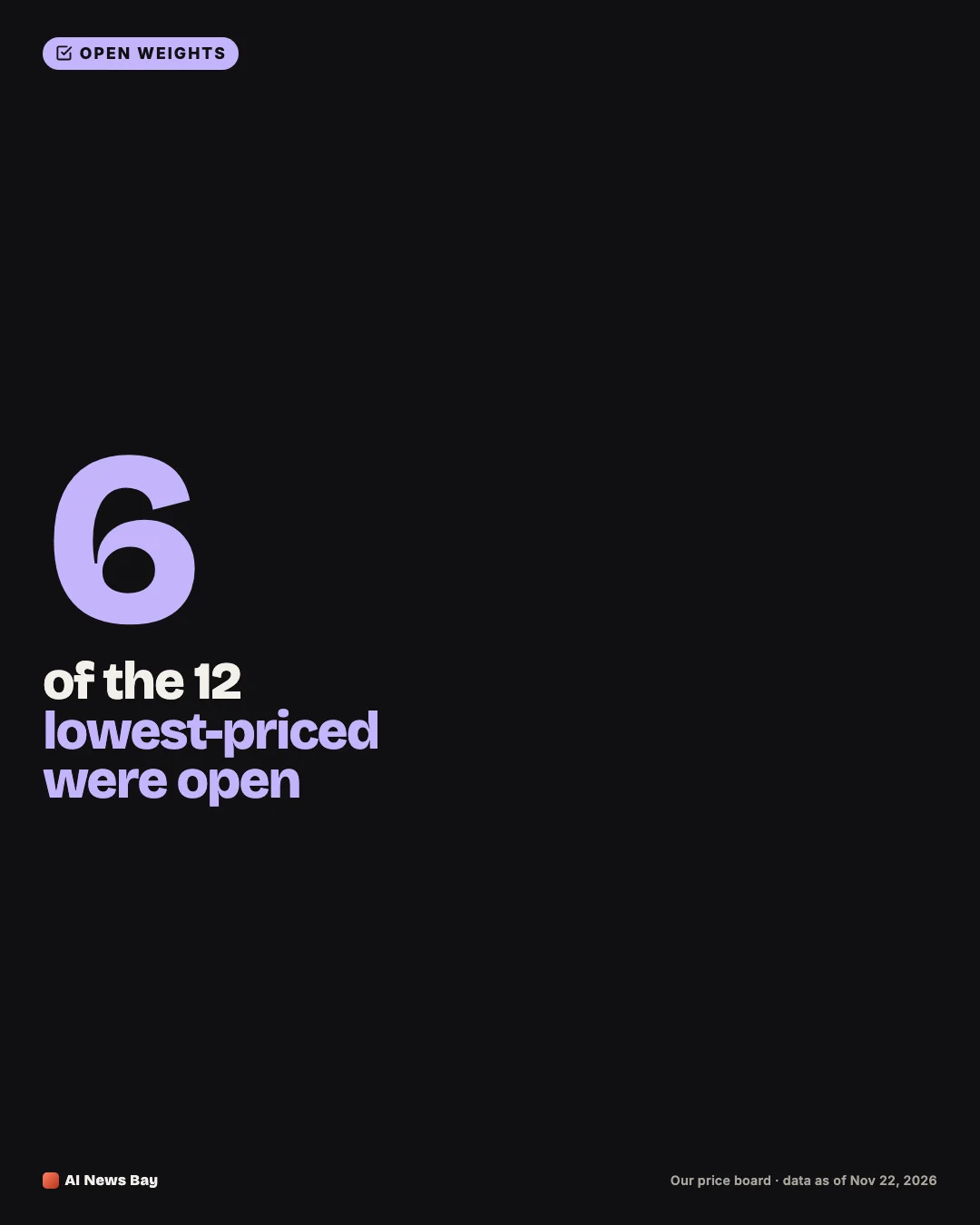
On our board the low end of the price range is crowded with open-weight models. Ranked by our board’s blended price on 2026-11-22, six of the 12 lowest-priced models were open-weight. Sort the price board yourself to see the current order, which changes as prices move.
When Each Makes Sense
Lean towards open weights if:
- data must stay inside your own systems
- you need a fixed model version for years
- you have very high, steady volume and the skills to run servers
Lean towards a closed API if:
- you want the most capable models from the largest labs on our board
- you’d rather not run infrastructure
- your volume is modest or unpredictable
You don’t have to choose just one. A common pattern is to use both: a closed flagship for the hardest tasks and an open-weight model for high-volume simple ones.
Myth vs Fact
| Myth | Fact |
|---|---|
| Open-weight means open source | Open source AI, as the OSI defines it, also asks for training code and data information |
| Open models are always free | The weights may be free to download, but running them costs hardware or hosting fees |
| You must self-host an open model | Many are also offered through their maker’s API |
What This Means for You
- Developers: test an open-weight model through an API first; self-host only if control or volume justifies the operations work.
- Founders and team leads: weigh data control and version stability against the staff time to run models; read each licence.
- Curious beginners: open-weight models are ones anyone can download; closed ones you can only use through the company’s service.
Copy-Ready Decision Questions
- Must our data stay inside our own systems?
- Do we need the same model version for years?
- Do we have people to run and update servers?
- Is our volume high and steady enough to justify hardware?
- Have we read the model’s licence terms?
- Have we tried both kinds on 20–50 of our own examples?
If your main AI provider disappeared tomorrow, how much would it matter that you couldn’t run its model yourself?
Bottom Line
Open-weight models give you the weights and the control that comes with them; closed models give you convenience and, on our board, the largest labs’ flagships. On 2026-11-22, 12 of 42 models on our board were open-weight, many of them among the lowest-priced. Compare them on our price board, explore our collection Open models you can run on your own computer, and use our model checklist. Want these updates by email? Sign up here, or follow new guides and data stories through our RSS feed.